
How to Store Rice Properly: A Complete Guide for Longer Freshness
Principles of Grain Preservation and Spoilage Mechanics
Food preservation science demonstrates that staple cereal grains such as rice maintain nutritional stability over decades when shielded from environmental degradation catalysts. Ambient humidity, atmospheric oxygen, elevated temperature, and biological contaminants drive post-harvest spoilage. Long-term stabilization requires suppressing enzymatic action, halting lipid oxidation, and maintaining low moisture equilibrium.
Long-term freshness starts with grain quality right from the source, which is why beginning with properly processed, debris-free stock from a trusted producer like Tulsi Rice & Pulse Mill (TRPM) gives your pantry an immediate advantage against spoilage and pests.
Cultivar Physiology and Lipid Degradation
Baseline longevity depends fundamentally on anatomical morphology across grain cultivars. Polished white cultivars undergo mechanical detachment of the bran and germ, leaving an endosperm of stable carbohydrates and proteins. Containing negligible lipids, the substrate required for hydrolytic rancidity is absent.
Whole Grain Vulnerability Versus Polished Endosperms
Conversely, whole brown grain retains the intact bran coating and germ, housing polyunsaturated fatty acids and lipase enzymes. Atmospheric oxygen catalyzes rapid enzymatic hydrolysis, generating volatile aldehydes and rancid off-flavors within six to twelve months at room temperature.
Environmental Deterioration Catalysts: Moisture and Thermal Dynamics
Internal moisture content constitutes the critical metric governing grain preservation. Cereal moisture must remain below 14% to prevent mold proliferation, while moisture below 12% is recommended for extended reserves. Moisture exceeding 14% fosters mycotoxigenic Aspergillus development. Maintaining reserves below 70°F (21°C), or ideally under refrigeration at 40°F (4°C), effectively preserves cellular stability.
Impact of Commercial Rice Milling and Sorting on Storage Durability
Protecting Grain Integrity Through Mechanical Rice Milling
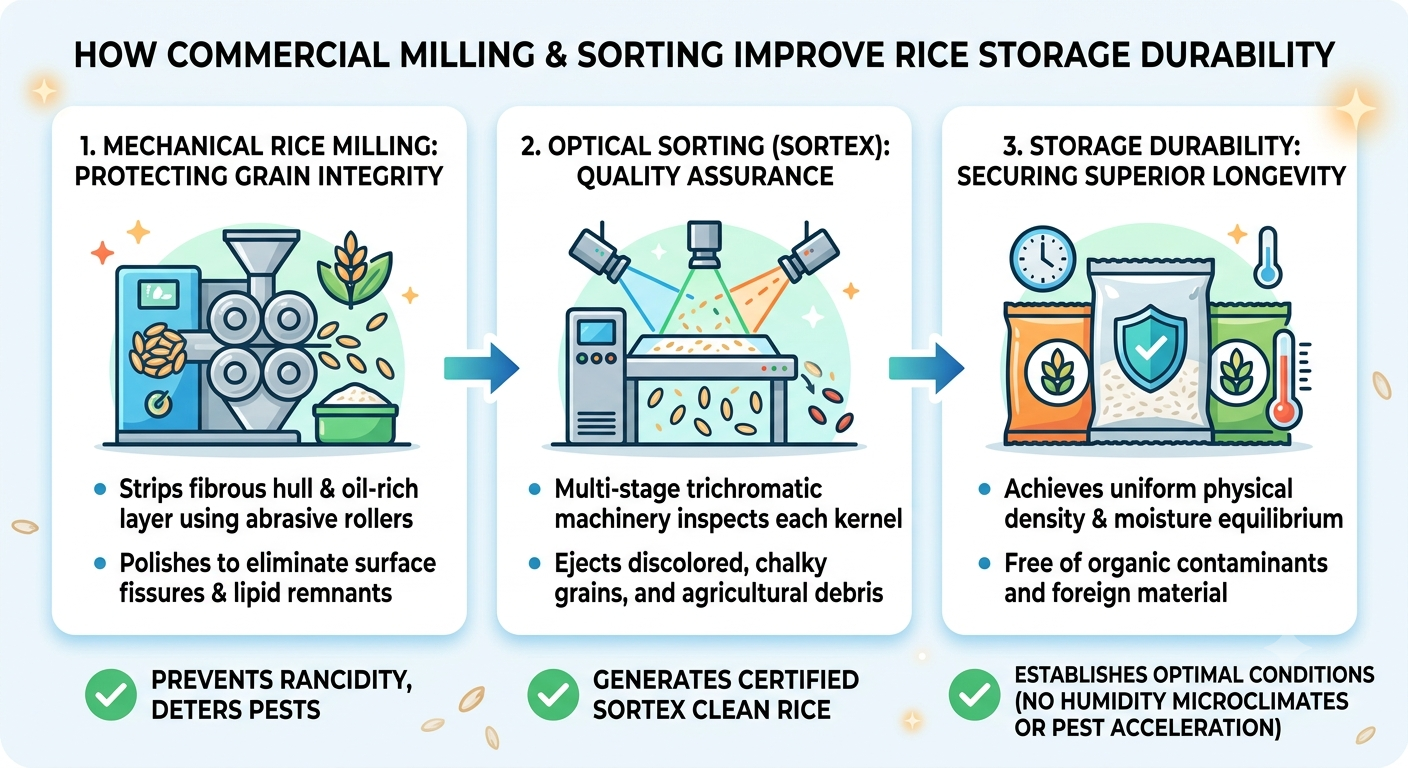
Post-harvest processing establishes the foundational baseline for grain longevity before final packaging occurs. Industrial rice milling utilizes multi-stage abrasive rollers to strip the fibrous hull and oil-rich aleurone layer from the kernel. Advanced polishing eliminates surface fissures and lipid remnants that would otherwise initiate rancidity or attract opportunistic pests.
Quality Assurance: Sourcing Sortex Clean Rice from an Established Rice Manufacturer
Securing superior storage longevity requires obtaining stock from an experienced rice manufacturer capable of comprehensive post-milling purification. A professional rice manufacturer employs multi-stage trichromatic optical sorting machinery to generate certified Sortex Clean Rice. This optical inspection detects and ejects discolored kernels, chalky grains, and agricultural debris.
Procuring Sortex Clean Rice ensures that stored inventory possesses uniform physical density and moisture equilibrium, completely free of organic contaminants. Foreign material and broken kernels create localized humidity microclimates inside sealed containers, accelerating pest incubation. Automated optical sorting removes these biological catalysts, establishing optimal conditions for storage.
Optimal Containment Systems and Atmospheric Control for Rice
Short-Term Packaging Solutions for Household Pantries
For standard consumer rotation cycles spanning three to twelve months, basic permeable packaging such as paper sacks must be discarded immediately upon purchase. Porous materials permit ambient moisture absorption and insect entry. Transferring stock into airtight canisters of food-grade polyethylene, polypropylene, or glass isolates the grain from humidity. Hermetic gaskets also prevent volatile aroma transfer from culinary spices.
Hermetic and Anoxic Storage for Multi-Decade Reserves
Achieving multi-decade longevity requires impermeable barrier materials combined with modified atmospheric technology. Metallized Mylar pouches, manufactured at 5 to 7 mils thickness, present an exceptional physical barrier against light, oxygen, and vapor. Enclosing iron-based oxygen scavengers reduces internal oxygen below 0.01%, suffocating pests and stopping oxidation. Placing sealed pouches inside gasketed food-grade buckets provides structural defense against rodents.
To understand how automated dehusking, polishing, and grading preserve grain stability long before packaging, explore our detailed walkthrough of the modern rice mill process.
Biological Hazard Mitigation: Entomological and Microbial Prevention
Thermal Eradication of Weevils and Natural Repellents
Pantry infestations typically originate from microscopic eggs deposited by grain weevils (Sitophilus oryzae) prior to packaging. Freezing dry stock at 0°F (-18°C) for at least 72 hours reliably destroys all embryonic, larval, and adult insect life stages. Stock must return to room temperature before unsealing to prevent condensation. While botanical bay leaves discourage roaming insects, complete eradication requires oxygen-depleted packaging.
Microbiological Safety Protocols for Prepared Grains
Hydrated, cooked grains present acute microbiological vulnerabilities governed by Bacillus cereus, an endospore-forming bacterium resilient to boiling temperatures. When cooked starches linger between 40°F and 140°F (4°C and 60°C), surviving spores germinate and synthesize heat-stable enterotoxins. Cooked starches must cool to 70°F (21°C) within two hours and reach 40°F (4°C) within four hours. Refrigerated portions remain safe for three to five days.
Comparative Storage Specifications Across Grain Classifications
| Grain Classification | Equilibrium Moisture | Packaging Method | Storage Environment | Projected Longevity | Primary Spoilage Factor |
| Polished White Rice | 12% to 14% | Unsealed retail sack | Ambient pantry (70°F / 21°C) | 1 to 2 years | Moisture uptake, pest entry |
| Polished White Rice | Under 12% | Mylar pouch with O₂ absorber | Cool basement (< 60°F / 15°C) | 25 to 30 years | Physical starch breakdown |
| Whole Grain Brown Rice | 12% to 13% | Airtight glass canister | Ambient pantry (70°F / 21°C) | 6 months | Lipid auto-oxidation |
| Whole Grain Brown Rice | Under 12% | Vacuum pouch or sealed jar | Freezer (0°F / -18°C) | 18 to 24 months | Slow lipid degradation |
| Parboiled Grain | 11% to 13% | Mylar with O₂ absorber | Ambient pantry (< 70°F / 21°C) | 20 to 25 years | Humidity intrusion |
| Cooked Preparations | Saturated | Sealed food container | Refrigerator (< 40°F / 4°C) | 3 to 5 days | B. cereus proliferation |
Strategic Guidelines for Sustained Freshness
Strategic preservation of rice requires a synchronized defense against biochemical, environmental, and biological vectors. Sourcing cleanly milled grains, conducting thermal disinfestation, and storing reserves inside hermetic containers with oxygen absorbers guarantee exceptional culinary quality and food security for decades.
Conclusion
Maximizing grain longevity and protecting food quality requires understanding both biological preservation and processing standards. Long-term storage success begins at the source with thorough cleaning and moisture management. Partnering with a dedicated processor like Tulsi Rice & Pulse Mill ensures incoming supplies meet rigorous post-harvest criteria. By deploying automated optical sorters and precision Satake milling machinery, Tulsi Rice & Pulse Mill delivers Sortex clean grains free of foreign matter, damaged kernels, and excess surface bran. Combining high-purity grains with airtight, moisture-controlled containment guarantees that your pantry inventory remains fresh, aromatic, and shelf-stable for years to come.
Frequently Asked Questions Regarding Long-Term Preservation
Q: Can properly packaged white rice maintain stability for thirty years?
A: Scientific evaluations confirm that polished white grains sealed in oxygen-depleted Mylar pouches with iron scavengers and held below 60°F (15°C) retain caloric value, texture, and flavor profile for 25 to 30 years.
Q: Why does brown whole grain exhibit a shorter shelf life than white varieties?
A: Whole brown grain retains its nutrient-dense germ and bran layer, which contain volatile plant lipids. When exposed to atmospheric oxygen and warmth, these lipids undergo auto-oxidation, generating rancidity and sour flavors within six to twelve months.
Q: What sensory indicators reveal that dry or prepared grains have spoiled?
A: Dry stock exhibits deterioration through visible clumping, insect webbing, musty odors, or kernel discoloration. Spoiled cooked grains emit sour aromas, change color, or develop an uncharacteristic slimy surface texture.
Q: Does prior freezing completely eliminate pantry pests and weevils?
A: Exposing dry grains to 0°F (-18°C) for at least 72 hours terminates all life stages of pantry insects, including dormant weevil eggs. The stock must reach room temperature before unsealing to avoid atmospheric moisture condensation.
