Industrial Engineering Inside an Automated Rice Mill
The modern rice mill has transformed post-harvest agricultural processing from an unpredictable manual chore into a high-precision science. Traditional hulling setups frequently cracked kernels and left stones or husk fragments in the grain. Today, an automated ricemill facility integrates continuous cleaning, whitening, polishing, and digital grading stages to deliver export-grade grain.
For a commercial rice supplier, operational consistency depends on fulfilling strict purity, grain length, and color metrics. Modern processing protocols eliminate physical grain stress, stabilize recovery rates, and remove human handling. By incorporating high-capacity sorting technologies developed for rice and pulse processing lines, a cutting-edge rice mill guarantees higher head rice recovery with zero manual handling.
Step-by-Step Operations in the Modern Rice Milling Process
Converting raw paddy into polished white rice requires a continuous, multi-stage mechanical sequence. Every export-grade rice manufacturer depends on this flow to maintain grain integrity while generating usable by-products like husk and bran. Consistent rice milling balances bran removal with kernel protection to stop internal grain cracking.
Primary Intake and Shelling at the Rice Mill
Harvested paddy arriving from the field contains organic and mineral debris that must be cleared immediately.
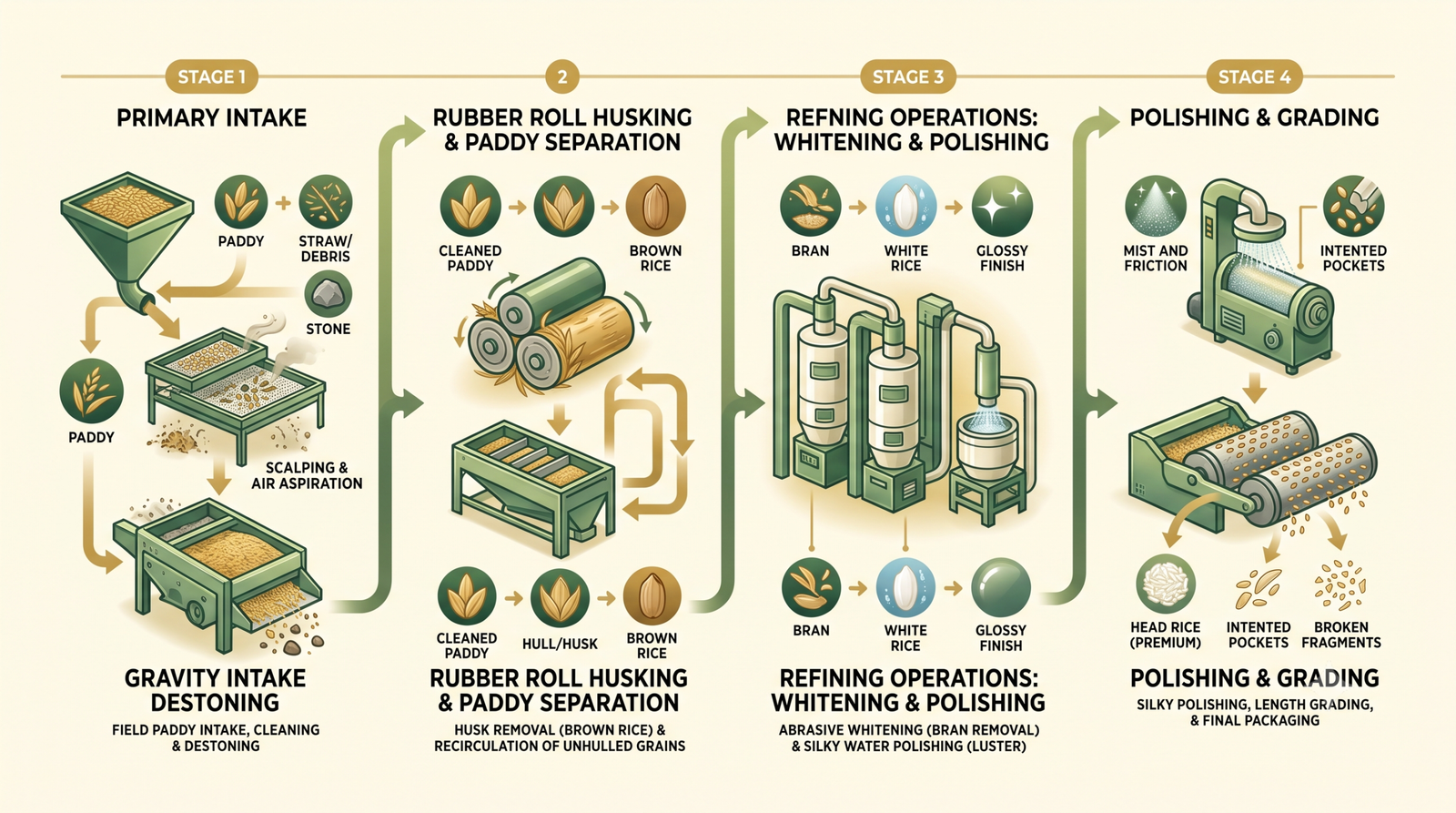
Scalping, Aspiration, and Destoning
- Scalping and Air Aspiration: Raw paddy arriving at the rice mill carries straw, dust, and weed seeds. Oscillating wire screens scalp large debris, while closed-loop aspiration chambers draw out light chaff and empty hulls.
- Gravity Destoning: Vibratory destoners exploit specific gravity differences between grain and stone. Fluidizing air decks float the lighter paddy upward while sinking heavier gravel and soil balls. This critical step shields downstream rice mill equipment from abrasive damage.
Rubber Roll Husking and Paddy Separation
- Rubber Roll Husking: Clean paddy passes through rubber rolls rotating in opposite directions at differential speeds. The shear action strips off the outer husk to yield brown rice without crushing the kernel.
- Paddy Separation: Because huskers operate with deliberate clearances to curb breakage, up to 15% of grains remain unhulled. Specific-gravity separators divide the output, returning unhusked paddy to the sheller while brown rice flows forward through the rice mill line.
Refining Operations: Whitening, Polishing, and Grading
Brown rice retains its fibrous outer pericarp and germ. The milling line systematically strips and buffs these layers to produce consumer-ready white grain.
Multi-Stage Abrasive Whitening
Inside the rice mill, multi-break vertical whiteners remove the pericarp and aleurone layers using abrasive carborundum stones. Performing this peeling across two or three gentle passes minimizes friction heat, which prevents internal micro-fissuring.
Mist Polishing and Indented Cylinder Grading
- Silky Water Polishing: A silky mist polisher introduces fine moisture atomization under friction. This buffs remaining bran dust into surface crevices and clears free fatty acids, creating a glossy sheen that resists oxidation.
- Length Separation: Every commercial rice mill uses indented cylinder length graders to isolate broken fragments from head rice. Rotating indented pockets lift broken tips away, discharging whole grains into the prime packaging stream.
Advanced Sortex Technology for Producing Sortex Clean Rice
Producing genuine Sortex Clean Rice represents the ultimate quality benchmark in food grain processing. At this stage, an advanced rice mill relies on computer vision to remove defective kernels that slip through mechanical sieves.
Optical Camera Inspection and Defect Ejection at the Rice Mill
The optical sorter funnels polished rice down ultra-smooth chutes, creating an accelerated, single-layer curtain in free-fall. High-resolution CCD cameras and infrared sensors scan both sides of each falling kernel at thousands of frames per second.
This optical inspection enables the rice mill to identify and eject hidden defects instantly:
- Discolored, chalky, peck-damaged, or immature kernels.
- Foreign elements such as glass shards, white stones, plastics, and dead insects.
- High-speed pneumatic valves that release microsecond blasts of compressed air.
- Defective kernels fired into reject bins without disturbing surrounding accepted grains.
Operational Metrics Across Industrial Milling Stages
| Milling Operation | Equipment Utilized | Targeted Contaminants | Operational Metric |
| Grain Intake & Cleaning | Scalper screen and destoner | Straw, mud, stone, ferrous parts | Mineral impurities < 0.25% |
| Dehusking | Rubber roll sheller | Insoluble outer hulls | Shelling efficiency > 85% |
| Paddy Separation | Compartment gravity table | Recirculated unhulled paddy | Total brown rice segregation |
| Whitening | Abrasive vertical whiteners | Pericarp and aleurone layers | Whiteness index (L*) targets |
| Friction Polishing | Silky mist polisher | Residual loose bran dust | Extended storage stability |
| Optical Sorting | Sortex color sorter | Chalk, peck, yellowing, glass | Overall purity > 99.9% |
| Size Grading | Indented cylinder sifter | Broken kernels, tips, chips | Precise head rice ratios |
Global Standards in Rice Mill Production and Supply
International grain buyers demand rigorous quality assurance and full supply chain traceability. Leading rice manufacturers in india have adopted automated milling systems to supply top-tier varieties worldwide. Working with a certified rice manufacturer guarantees uniform grain length and minimal broken grains.
A reputable wholesale rice supplier uses continuous rice mill inspection to prevent lot contamination and preserve aroma. For international procurement, contracting with an experienced wholesale rice supplier or top rice manufacturers in india ensures reliable container-load delivery. Facilities like Tulsi Rice & Pulse Mill showcase how modern infrastructure and dual-crop sorting elevate grain purity for commercial markets.
Frequently Asked Questions
Q: What differentiates Sortex Clean Rice from regular milled rice?
A: Sortex Clean Rice undergoes high-speed optical camera sorting to remove discolored grains, chalky kernels, and foreign matter. Regular milled rice only uses mechanical screens, which leave subtle visual and physical defects behind.
Q: What is the primary role of a modern rice mill?
A: A modern rice mill cleans, husks, whitens, polishes, and optically sorts raw paddy to maximize head rice recovery and produce impurity-free grain.
Q: What is the ideal moisture content for paddy before entering a rice mill?
A: Paddy must be dried to 13%–14% moisture before entering a rice mill. Moisture above 14% crushes grains during milling, while levels below 12% cause internal cracking and high breakage.
Q: Why do international buyers prefer rice manufacturers in India?
A: Leading rice manufacturers in india operate fully automated multi-break milling and optical sorting plants that meet stringent global food safety and purity standards.